“I get it” hits different when you actually do.
Study Garden finds the concept you're missing and checks it with you, one small question at a time. Only what you do on your own counts toward moving up.
Solve |x + 5| = 3.
From “I don't get it” to actually getting it
You try, and get stuck
Saying “I don't get it” is fine. So is a wrong answer. Either one tells the tutor to slow down.
ExerciseSolve |x + 5| = 3.
YouI don't get it.The tutor finds the missing concepts
It splits the exercise into its concepts, the small ideas it depends on, and starts with the first one you're unsure of. It remembers what you showed in earlier sessions.
Concepts to practice first1. What the bars mean2. The value inside the barsTutorLet's go back one step. The bars mean distance from zero.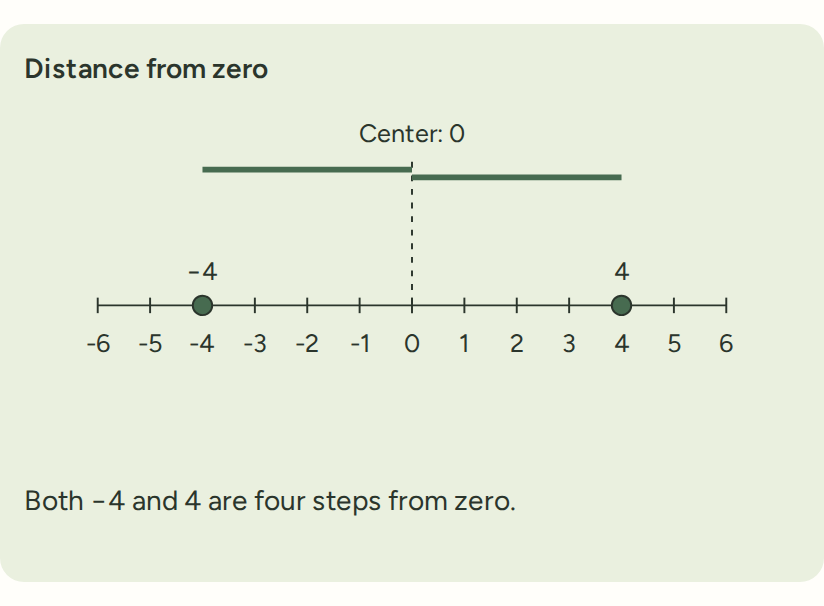
Concept checks, one concept at a time
Short questions on just that concept, until you pass three different ones. Then the next concept, the same way. The exercise waits at the top.
Concept check · answer this nowWhat is |−7|? → 7What is |0|? → 0Can a distance be negative? → NoCorrect · concept check passed. 3 of 3 passed.Back to the exercise: “Ooohh”
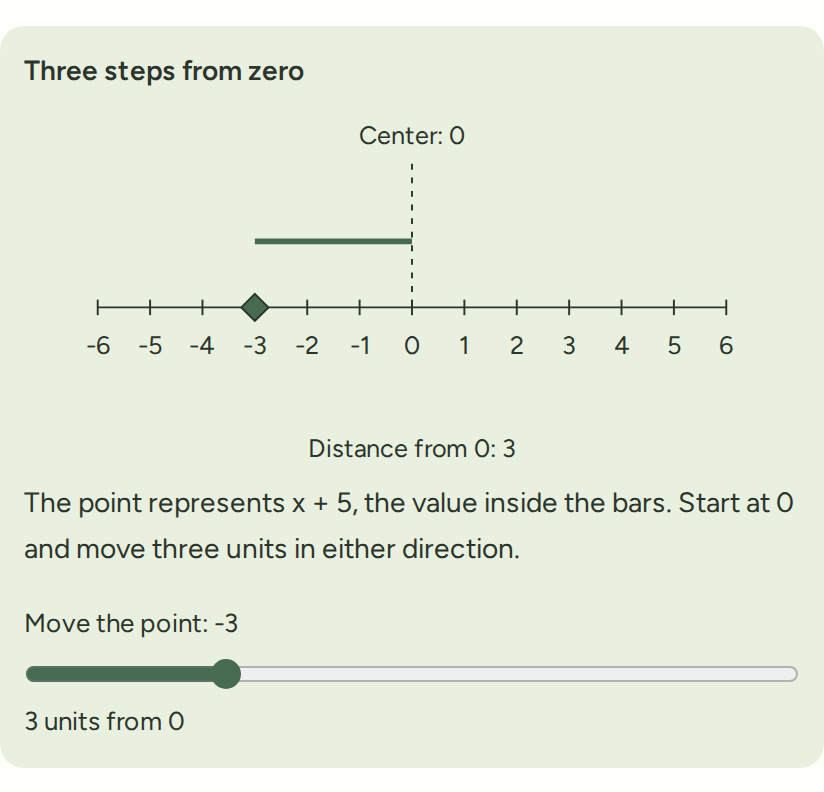
With both concepts in place, the tutor brings you back, with a picture to try it on.
TutorSo x + 5 must be three steps from zero. Move the point. Where can x + 5 be?YouOoohh. 3 or −3. So x = −2 or x = −8.Then show it on your own
That answer came with help, so it's saved as practice. The next new exercise is yours alone, and that one counts. Pass 3 of your next 4 to move up, with a level-up card to share.
Correct with help · practice, not counted toward your checkpoint.New exerciseSolve |x − 2| = 5.
Youx = 7 or x = −3Correct · exercise passed. It counts toward your checkpoint.Checkpoint: pass 3 of 4 to move up to Difficult1 of 3 passed
Two kinds of check
Concept check
- One small idea inside a topic.
- A short question, often right after a mistake.
- Pass 3 different ones, with one slip allowed.
- Finds the missing piece and fixes it.
Checkpoint
- The whole topic, at your level.
- Full exercises, new each time.
- Pass 3 of your next 4, on your own, first try.
- Moves you up a level.
They never mix. Concept checks don't count toward a checkpoint. While you work on a concept, your checkpoint waits, and nothing is lost.
And later, a concept is secure only when you still know it in a later session. Recall cards bring it back before it fades.
Why it works: In a review of decades of studies, tutors that checked each step of the thinking came close to human tutors. Tutors that checked only final answers did far less. And in a 2026 trial, AI help worked best right after a mistake.
VanLehn, 2011 · Oreopoulos, Liut, Sungu & Low, 2026 (working paper)A plan all the way to test day
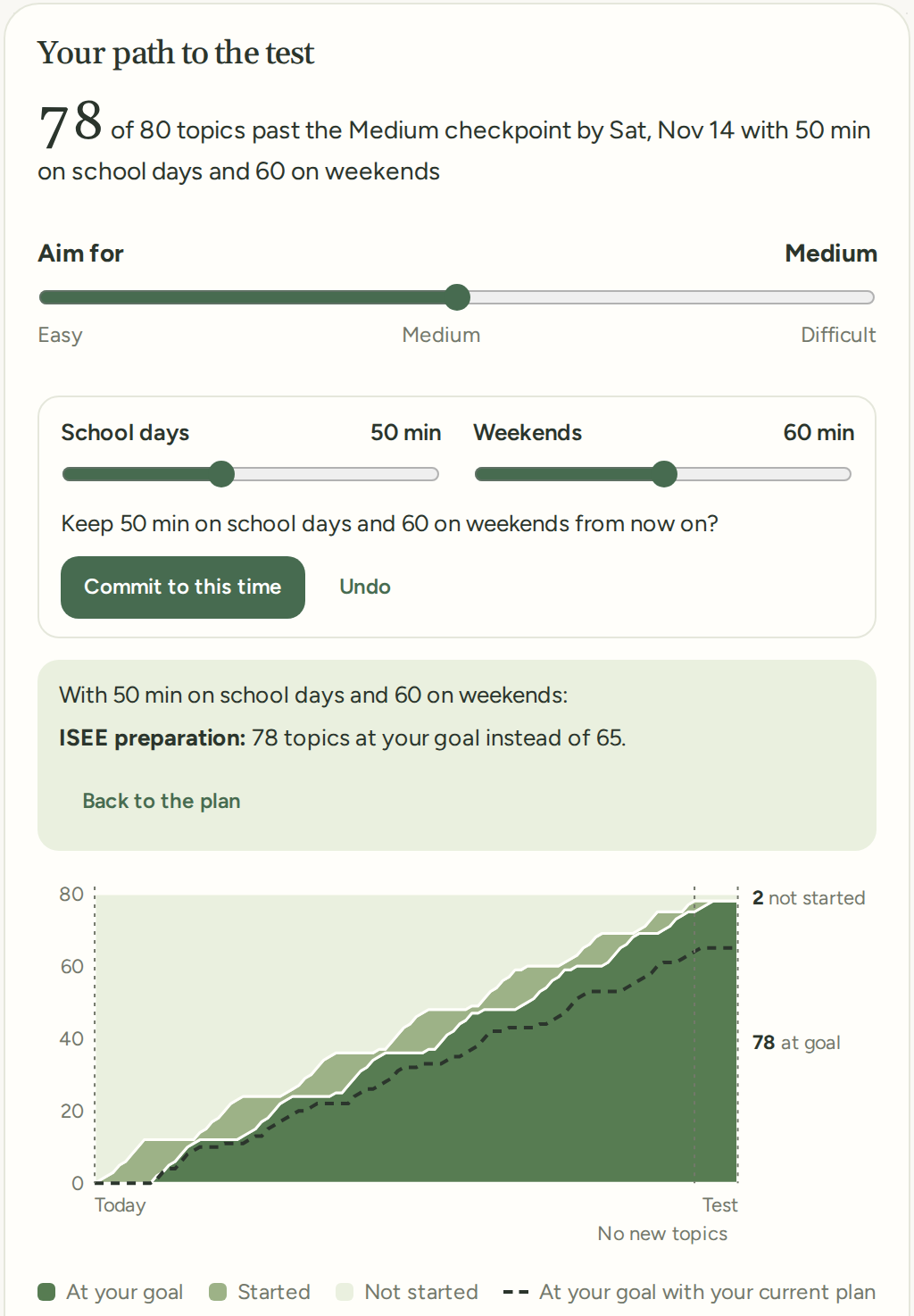
All five sections, in 80 topics. Set your test date and your usual week. Study Garden plans each day and shows where you'll be on test day. Drag a slider to see what more time, or a higher goal, would change.
- Each topic comes back a week later to move up: spaced, not crammed.
- Busy day? Mark it, and the plan adjusts.
- Pace is measured from your own work.
- If the plan won't fit, you see it weeks early.
Look back at every week
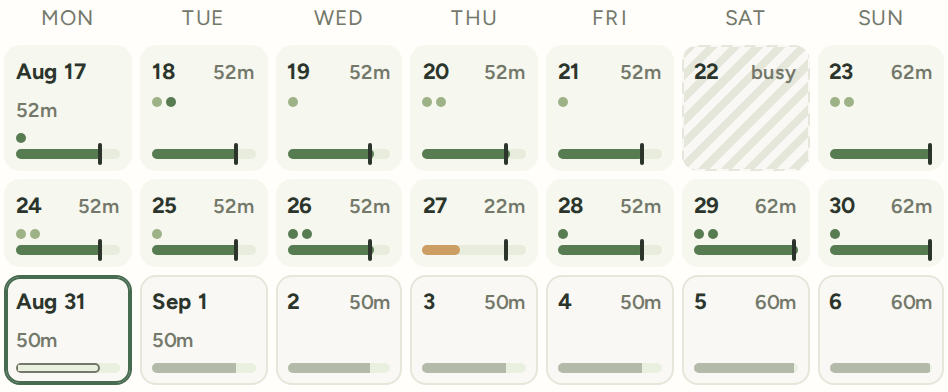
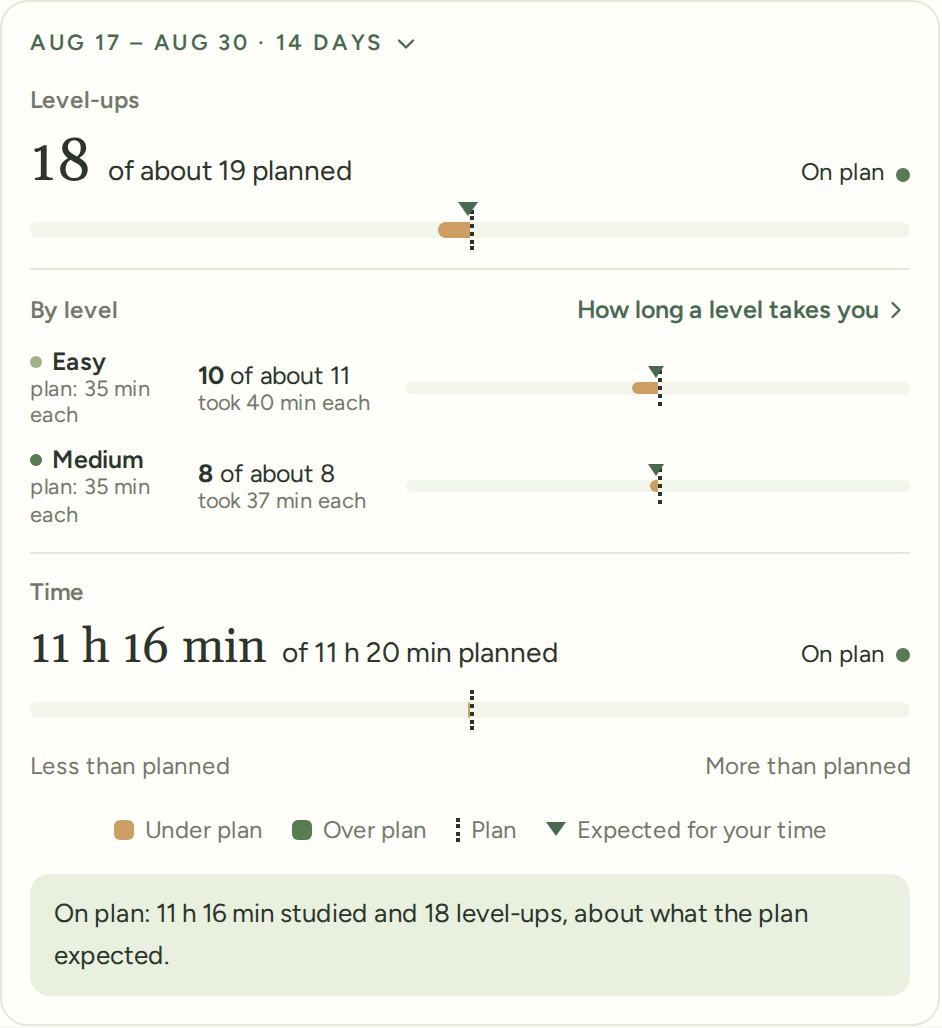
Time counts: showing up builds the habit, and your streak keeps track. But minutes alone don't show what you learned, so Study Garden puts your time beside what it brought: level-ups, each one passed on your own.
Not taking the ISEE? Photograph a syllabus or a few pages, and get a study for any class.
You see what's real
An honest record
What they did on their own, what they practiced with help, and the tutor's notes on each topic.
You're in charge of AI
It starts off. You turn it on, choose the model and set a monthly spending limit.
Private by design
No ads. Never sold or used to train AI. Download or delete anything, anytime. Under 13 needs your verified consent first.
Why it works this way
Answers on tap can backfire
In a study of nearly 1,000 high schoolers, chatbot answers raised practice scores but lowered exam scores. Hints instead of answers avoided that.
Your tutor gives hints and explanations, and a full solution if you ask. An answer you give after help is saved as practice, never as passed.
Bastani et al., 2025Remembering beats rereading
A review of ten study techniques rated two the most useful: testing yourself, and spreading practice over days. Rereading rated low. A review of 222 classroom studies found that quizzes raised achievement.
Recall cards ask you to write what you remember before you see the answer. How it felt sets when the card comes back, later each time you remember it.
Dunlosky et al., 2013 · Yang et al., 2021Passing once isn't knowing
In a 2026 trial, requiring three right in a row didn't by itself improve learning on a later test. In another study, rereading won after five minutes, but testing yourself won after two days.
A concept is secure only after you pass 3 different concept checks on your own, across at least two sessions. After 30 days without one, it shows Review due.
Oreopoulos, Liut, Sungu & Low, 2026 (working paper) · Roediger & Karpicke, 2006Every finding we've built in, and where its evidence stops
Study Garden is new. We haven't measured its effect on test scores yet, and we'll share what we learn.
Julien, founderI built Study Garden after trying everything I could find for my daughter.
The private tutors we tried either talked past her or helped her too much through the hard problems. None really met her at her level. Then there was the scheduling: school, clubs and competitions changed every week. And the ISEE Upper Level, across every topic, plus the odd summative for school and French grammar lesson, needed more hours than any human tutor could give.
The apps had the opposite problem. Khan Academy is brilliant, but on her own, she found it hard to get unstuck on the odd concept. I can't count how many times I said “watch the video again until you understand,” until we all gave up. ChatGPT was great at explaining one problem, but it gave her no program to follow. Each left the hardest part to her: getting unstuck alone, or steering herself through every topic a big test covers. Nothing did both, so I had to build it.
It started as an experiment: the tutor I wished we had. Always there, always patient, ready to go back to whatever level she needs, in any subject, and walk her back up to real understanding. Upload a syllabus, set the test date, and a minute later you're practicing, really learning new concepts, and you can see how much time each day it takes to get there.
We've been improving it together ever since. She now picks up new topics, and keeps old ones sharp, faster than I've ever seen. Two hours of focused work with her tutor is no stretch for her. As a parent, that feels like a miracle.
It also helps motivate her to read more. It recommends books, keeps her reading journal, and helps her write down her thoughts, guess where a story is going, and sharpen her writing.
We're so excited that it's time to share it with more families. Oh, and the headline? Her words.
Joining is by invitation
Study Garden is in a private pilot. Ask a family who uses it for an invitation.
- Open your invitation link.
- A parent sets up your household.
- Your learner signs in and starts.
No invitation? Write to contact@mystudygarden.com
Questions families ask
Does it just give answers?
No. It gives hints, explanations and a full solution if you ask. Answers after help are saved as practice, never as passed.
Who is it for?
Middle and early high school, starting with eighth grade. Learners under 13 need a parent's verified consent first.
Which AI does it use?
Claude, by Anthropic. For learners 13 and older, a parent can choose OpenAI instead.
Can the AI get things wrong?
Yes, any AI can. So Study Garden checks its work:
- Test myself questions are solved a second time by a separate AI review that can't see the answers. If any answer disagrees, the set isn't used.
- Printed concept sheets get the same kind of review. Calculations, dates and quotes are worked out again from scratch. A page with a mistake is fixed before it prints.
- In the chat, every reply is checked against the teaching rules before it's saved. Quotes, dates and distances in pictures come from the saved text or are measured by the app.
Unsure grading waits for review instead of counting. And you can always ask why.
What does it cost?
You pay for the AI tokens you use: the bits of text the AI reads and writes. Start with a credit, then set your top-up amount and a monthly spending limit.